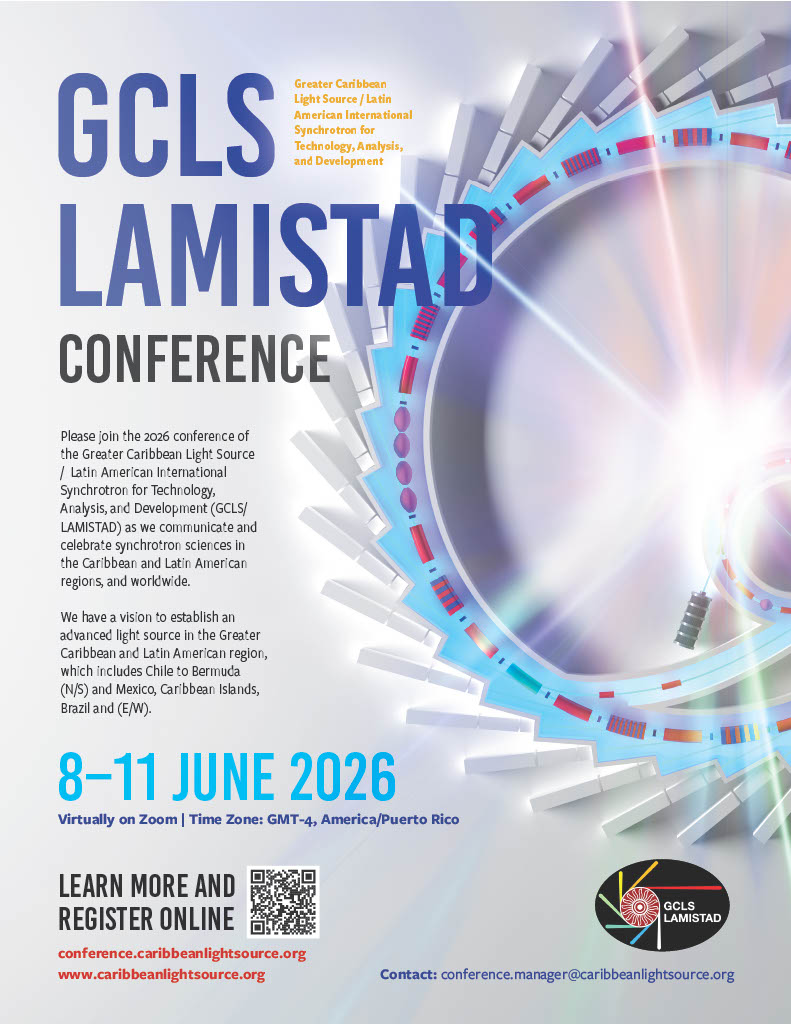
Greater Caribbean Light Source / Latin American International Synchrotron for Technology, Analysis, and Development (GCLS/LAMISTAD) Conference

America/Puerto_Rico
Online by Zoom
Description

The time zone is controlled by you as an Indico Setting (top right). The session times will therefore be shifted if you are not set to San Juan, Puerto Rico time (GMT-4)

Please join the 2026 conference of  the Greater Caribbean Light Source /  Latin American International Synchrotron for Technology, Analysis, and Development (GCLS/LAMISTAD) as we communicate and celebrate synchrotron sciences in the Caribbean and Latin American regions, and worldwide.

We have a vision to establish an advanced light source in the Greater Caribbean and Latin American region, which includes Chile to Bermuda (N/S) and Mexico, Caribbean Islands, Brazil and (E/W).

Programme Outline

Advanced light sources support multiple disciplines. The conference program will cover a broad range of topics in 

  • Science and Engineering 
  • Education and Training
  • Science Policy and Diplomacy


Register Now for Zoom Link


Participation

The Organizing Committee of this meeting observes the basic policy of non-discrimination and affirms the right and freedom of scientists to associate in international scientific activity without regard to factors such as ethnic origin, religion, citizenship, language, political stance, gender, sex or age, in accordance with the Statutes of the International Council for Science.

No barriers, which would prevent the participation of bona fide scientists, will exist at this meeting.


Click to download PDF of Conference Flyer


Registration
Greater Caribbean Light Source (GCLS/LAMISTAD) Conference
GCLS/LAMISTAD Conference Management
    • 10:00 11:00
      Opening Plenary Session: Opening Session
      • 10:00
        Science and User Programs at the Brazilian Light Source 1h

        The director of the Brazilian Synchrotron Light Laboratory (LNLS) will give an overview of the facility, the science and user programs; their role in global science production, user training and development in the Latin American and Caribbean region, and in science diplomacy with both the so-called Global North and Global South.

        Speaker: Dr Harry Westfahl Jr. (Director Brazilian Synchrotron Light Laboratory (LNLS))
    • 11:00 12:00
      Science and Engineering Research
      • 11:30
        NSF-PREM Student to Synchrotron User: A Scientific Journey Through CHESS 30m

        Access to synchrotron facilities provides unique opportunities for the scientific and professional development of early-career researchers, especially those from underrepresented regions such as Puerto Rico. This presentation highlights my trajectory as a graduate student whose scientific path has been enriched through long-term involvement with the Cornell High Energy Synchrotron Source (CHESS). Beginning in 2019 with a three-month internship during a major synchrotron upgrade, the experience provided direct exposure to operating a large-scale research facility, including technical and mechanical work. Later, a second visit to CHESS allowed exploration of the scientific and experimental side of synchrotron research, leading to participation as a user of the facility. During a PREM-supported master’s project at Universidad Ana G. Méndez, continued involvement in synchrotron research strengthened an interest in energy materials and in scientific collaboration opportunities. This subsequently opened the door to participation in the NSF-supported High Magnetic Fields (HMF) beamline initiative and to continuing doctoral studies at the University of Puerto Rico, Río Piedras. Beyond the scientific findings, this work demonstrates how access to national facilities and NSF-supported programs can foster the development of young scientists, strengthen collaborations, and expand opportunities for advanced research in Puerto Rico.

        Speaker: Brenda Lee Vargas Pérez (University of Puerto Rico, Río Piedras Campus)
    • 12:00 13:00
      UNESCO-IUPAP Colloquium: UNESCO-IUPAP Session

      This is a separate program and requires a separate registration

      • 12:00
        Steven Chu opens 2026 IUPAP–UNESCO Colloquia - TODAY - 18h CEST (GMT+2) 1h

        The IUPAP–UNESCO International Colloquia on Physics for Society are back for 2026, continuing their mission of connecting physics with the major challenges facing our societies.

        The first colloquium of this year’s series, organized in the framework of the International Decade of Sciences for Sustainable Development (IDSSD), will take place online on 8 June 2026 18 CEST (Paris time) and will feature Nobel Laureate Prof. Steven Chu, William R. Kenan Professor of Physics, of Molecular and Cellular Physiology, and of Energy Science and Engineering at Stanford University.

        A pioneering physicist and former U.S. Secretary of Energy under President Barack Obama, Steven Chu was awarded the 1997 Nobel Prize in Physics for the development of methods to cool and trap atoms with laser light. Throughout his career, he has worked at the intersection of physics, energy, sustainability, and public policy, contributing to advances in biophysics, medical imaging, battery research, and carbon capture technologies.

        In his lecture, entitled “The challenges and opportunities of getting to net-zero GHG emissions”, Prof. Chu will discuss how industrial and agricultural revolutions have profoundly transformed the world while also contributing to climate change. Drawing on his experience in physics, energy policy, and sustainability, he will address the challenges of providing clean energy, water, air, and food for a growing global population, as well as the tensions between long-term climate goals and immediate concerns such as energy security and costs.

        The talk will also explore the progress, opportunities, and scientific challenges involved in achieving net-zero greenhouse gas emissions.

        The lecture will be open to the public and hosted on Zoom.
        https://www.unesco.org/en/articles/nobel-laureate-steven-chu-opens-2026-iupap-unesco-colloquia-series

    • 13:00 14:00
      Science and Engineering Research
      • 13:00
        Macromolecular X-ray Crystallography Studies of S. mansoni GAPDH in the Discovery and Design of Novel Anti-Schistosomal Compounds 30m

        Macromolecular X-ray crystallography is a powerful, sensitive technique that allows the identification of ligand-protein complexes, but it depends on crystals of high resolution and high tolerance to inorganic solvents. In this study, we investigated possible alternatives to the sole treatment of schistosomiasis, Praziquantel, by identifying small molecules that can interact with Schistosoma mansoni Glyceraldehyde-3-phosphate dehydrogenase (SmGAPDH). Identified in all life stages of parasitic worms causing schistosomiasis, a chronic parasitic disease of poverty that causes significant morbidity and mortality, accounting for 70 million disability-adjusted life years lost annually. SmGAPDH is characterised as a potential therapeutic target that plays a pivotal role in the parasite’s evasion of the human host and correlates with drug resistance. For this part of the study, full-length SmGAPDH was produced in Escherichia coli cells, purified to homogeneity using immobilised-nickel affinity chromatography and size-exclusion chromatography, and subjected to crystallisation trials. X-ray diffraction data were collected and used to analyse the electron density map, conduct structural analysis and functional studies, and run fragment screening. The full-length SmGAPDH was successfully purified and formed crystals within 24 hours under Morpheus and ShotGun1 screening, yielding high-resolution X-ray diffraction data at 1.8 Å and reproducible 2.5 Å data in the presence of DMSO. Evaluation of the electron density map shows a density for NAD+, unobserved in the previous studies. A life soak test identified 12 binding pockets and 5 potential ligands. These findings provide a fundamental structural basis for applying crystallographic screening to determine the functional aspects of SmGAPDH exploitable in fragment-based drug discovery and design, while prioritising the NAD-binding site.

        Speaker: Naledi Pilusa (University of johannesburg)
      • 13:30
        Recombinant Production and Biophysical Characterization Towards Structural Determination of Aspergillus niger RING finger domain 30m

        The most widely diagnosed disease globally is cancer, and it has been increasing in incidence and prevalence. The Global Cancer Observatory revealed that in 2022, the number of new cases stood at 20 million, and is set to increase by 77.5 % by 2050. The pro-cancer Retinoblastoma binding protein 6 (RBBP6) is a multi-domain protein that contains the Really Interesting New Gene (RING) domain, which varies across species. Previous multiple sequence alignment studies revealed that the RING domain of the mould Aspergillus niger differs from its human homolog due to the substitution of a cysteine for an aspartic acid. In this study, the A. niger RING domain was successfully expressed in BL21 (DE3) E. coli cells and purified by immobilized-metal affinity and anion-exchange chromatography. The purified protein was characterized using circular dichroism, standard 1D-1H NMR, 1D HET-SOFAST, 1D DOSY, thermal denaturation, thermal shift assays, size-exclusion chromatography with multi-angle light scattering, and differential light scattering. The protein was subsequently set up for crystallization trials. The secondary structural elements of the protein were elucidated by CD, which showed that the protein consisted mostly of β-sheets. 1D NMR revealed that the protein was well-folded and well-structured, with no disordered regions. Thermal denaturation showed the protein's thermal stability, with a Tm of 52°C. SEC-MALS and DLS indicated that the protein is monomeric, with a molecular weight of approximately 9.9 kDa. Crystallization trials yielded crystals under well conditions at 25°C in sodium fluoride, Bis-tris propane, and PEG3350. These conditions were optimized and tested on the ID30A/ MASSIF 1 ESRF beamline, but the protein did not diffract. This study provides a foundation for the structural determination of the A. niger RING domain, with the aim of designing and developing novel anticancer therapeutics.

        Speaker: Ms Mary George (University of Johannesburg)
    • 14:00 14:15
      Break 15m
    • 14:15 16:00
      Future-scaping Synchrotron Light Sources
      • 14:15
        Synchrotron Radiation : A Trillion Dollar Enterprise 30m

        The promotion of synchrotron radiation and in particular of new facilities often requires presentations to broad audiences, illustrating the benefits from its use. However, such presentations systematically encounter a problem: identifying good arguments to demonstrate the practical and financial benefits, in addition to the scientific ones. Until recently, one could not find reliable and detailed quantitative information, and it was necessary to make only qualitative statements with limited impact.

        However, this situation has been changed by a new and unique event: the COVID pandemics. Which stimulated sophisticated estimates of its financial impact by eminent economy experts. Such estimates also provide a solid background to evaluate the financial benefits from the use of synchrotron sources. In essence, synchrotron radiation crystallography was essential for the quick identification of the COVID virus structure, which allowed the timely development of vaccines. Thus, by analyzing the effects of the vaccines one can evaluate, in particular, the mitigation of the financial losses from the pandemics. Which also correspond to the financial benefits from synchrotron radiation activities. The results are absolutely astonishing, revealing that such activities are one of the most profitable enterprises of all times.

        Their benefits are not millions nor billions, but reach several trillions dollars, beating even the companies with the largest revenues in the world such as Amazon, Walmart and Apple,. And reaching an outstanding benefit/cost ratio. These realities, of course, boost the effectiveness of the promotion of existing and new facilities.

        Speaker: Prof. Giorgio Margaritondo (Ecole Polytechnique Fédérale de Lausanne (EPFL) and Istituto Italiano di Tecnologia (IIT))
      • 14:45
        The Puerto Rican Light Source (PULS) Initiative 30m

        Several Caribbean researchers and students, including from Puerto Rico, have been conducting materials and biological research studies at synchrotron facilities around the world. However, no synchrotron facility exists in the Greater Caribbean Region. A few years ago, a group of international researchers created the Latin American International Synchrotron for Technology, Analysis and Development (LAMISTAD) project with the aim to construct a Greater Caribbean Light Source (GCLS). Several Puerto Rican researchers are participating in the GCLS/LAMISTAD Committee. After the loss of the Arecibo Observatory, Puerto Rico might be a suitable site for a Big Science project such as the establishment of a synchrotron light source on the island. The Puerto Rican Light Source (PULS) initiative was created among Puerto Rican scientists participating in the GCLS/LAMISTAD Committee. Initial discussions about this initiative have been conducted with the Puerto Rico Science, Technology, and Research Trust. A white paper proposing a viability study was prepared. Recently, we communicated with the office of the Puerto Rico’s Resident Commissioner in Washington, D. C. to make him aware of these initiatives. In this presentation the present status of the PULS initiative and possible next steps will be discussed.

        Speaker: Dr Jorge L Colón (University of Puerto Rico, Río Piedras)
      • 15:15
        Commissioning of the STAR Compact Light Source Toward High-Brightness ICS X-Ray Generation 30m

        The commissioning of the STAR Research Infrastructure (Southern Europe Thomson Back-scattering Source for Applied Research), located at the University of Calabria in southern Italy, is currently in progress. STAR is a compact light source designed to generate monochromatic, tunable, and polarized hard X-ray beams with picosecond pulse duration through inverse Compton scattering (ICS), covering photon energies between 40 and 350 keV for a wide range of scientific and applied research applications.

        The STAR 2.0 upgrade project is being developed in collaboration with the Istituto Nazionale di Fisica Nucleare, coordinated by the INFN National Laboratories of Frascati together with the INFN Milan Unit and the LASA Laboratory. The facility will provide high-quality photon beams to two dedicated experimental stations for microtomography studies, served by two independent beam lines.

        This work presents the first major milestones achieved during the early commissioning phase, focused on the validation and characterization of the electron beam and high-power laser systems required for X-ray production. During commissioning, a laser-driven electron beam was successfully generated, transported, and characterized, reaching energies up to 150 MeV with charges above 200 pC and a pulse duration of about 5 ps (FWHM). In parallel, a high-energy infrared laser pulse of approximately 500 mJ and 5 ps duration was transported to the interaction point and synchronized with the electron beam with sub-picosecond timing precision.

        These achievements demonstrate the successful integration and operation of the main STAR subsystems and represent a key step toward full facility commissioning and the production of high-brightness ICS X-ray beams.

        Speaker: Luigi Faillace (INFN-Frascati)
    • 09:00 09:30
      UNESCO Opening Address
    • 09:30 11:30
      Future-scaping Synchrotron Light Sources
      • 09:30
        Overview of High Energy Photon (HEP) Facility 30m
        Speaker: tbd
      • 10:00
        DESY and Trans-Atlantic Science Dipomoacy 30m
        Speaker: Frank Lehner (DESY)
      • 11:00
        A Staged Pathway Toward Establishing an Advanced Science Center in Mexico and the Greater Caribbean 30m

        The aspiration of establishing a national advanced science facility, particularly a synchrotron light source, in an emerging economy such as Mexico, represents a profound commitment to fostering scientific progress and technological autonomy. Such advanced research infrastructure is widely recognized as the bedrock for a nation's position in global scientific advancement, yet its realization in developing countries presents multifaceted financial, technical, and human capital challenges. Past proposals for large-scale scientific facilities in Mexico and similar initiatives in other emerging economies have often encountered significant hurdles related to the substantial initial financial outlay, the protracted timeline from project inception to the delivery of first scientific results, and the scarcity of a sufficiently trained local workforce. This paper critically examines these historical obstacles and proposes a pragmatic, staged developmental model as a strategic pathway to mitigate these formidable challenges. Beginning with accessible, cutting-edge small-scale facilities, this approach systematically cultivates a robust local expert community, generates early scientific impact, and incrementally builds the technical and financial credibility essential for a future world-class synchrotron. Detailed descriptions of each proposed stage, encompassing advanced X-ray and electron-based techniques, are presented, highlighting their immediate scientific contributions and their foundational role in preparing for a larger facility. Emphasis is placed on the imperative of continuous engagement with the Mexican and Greater Caribbean scientific user communities, leveraging survey data and international usage statistics to define the precise scope and requirements for instrumentation. The paper contrasts the benefits of this phased strategy, including its optimized timeline and cost-effectiveness, with the inherent risks and extended lead times associated with a "greenfield" approach. Finally, we delineate the broad parameters for an optimally designed synchrotron storage ring, making specific comparisons with successful international facilities, to ensure both world-class performance and financial prudence, ultimately positioning Mexico as a leading hub for scientific discovery and innovation within the region.

        Speaker: Patrick Krejcik (SLAC)
    • 11:30 11:45
      Break 15m
    • 11:45 13:45
      Education and Training
      • 11:45
        Building a renewable energy, electrochemistry, and materials research community in Puerto Rico 30m

        A group of researchers in Puerto Rico from public universities (University of Puerto Rico, Río Piedras, Humacao, Cayey, and Mayagüez campuses) and private universities (Universidad Ana G. Méndez, Cupey and Gurabo campuses) has jointly successfully obtained NSF and DOE funding for projects to recruit, retain, and graduate undergraduate and graduate students conducting renewable energy research using nanostructured materials. These projects improve and broaden participation in these critical areas of research by increasing the number of participants from groups historically underrepresented in materials research completing degrees in STEM. These efforts are in collaboration with the Cornell High Energy Synchrotron Source (CHESS) at Cornell University in Ithaca, New York, the National Magnetic Laboratory (MagLab) in Tallahasse, Florida, the National Laboratory of the Rockies in Golden, Colorado, the SLAC National Accelerator Laboratory in Menlo Park, California operated by Stanford University, the San Francisco State University and the University of Texas at El Paso. A rapid transition to the use of renewable sources of energy (e.g., solar, wind) is needed if the worst consequences of climate change are to be avoided. Tackling this challenge requires developing new and innovative ideas on clean energy production and storage for energy applications. From solar cells, green hydrogen, and batteries to fuel cells, supercapacitors, and other technologies, materials science and electrochemistry are playing a central role in their development. The education and innovative collaborative materials research effort of our growing research community in Puerto Rico in collaboration with our partners will help to bring together and develop a diverse and talented scientific interdisciplinary community. Examples of research efforts in the area of nanostructured electrocatalysis for water splitting and fuel cells, nanostructures for dye-sensitized solar cells, and hybrid supercapacitors will be presented.

        Speaker: Dr Jorge L. Colón (University of Puerto Rico, Río Piedras)
      • 12:15
        LAAAMP 15m

        LAAAMP is a Joint Programme of the International Union of Pure and Applied Physics, the International Union of Crystallography, the Abdus Salam International Center for Theoretical Physics, and the International Union of Pure and Applied Biophysics, originally funded by the Grants Programme of the International Science Council.

        The Grants Programme creates innovative international initiatives of relevance to science and society led by ISC Member Unions. It seeks to facilitate active collaboration between Scientific Unions and other members of the ISC community (for example ISC Regional Offices, Interdisciplinary Bodies, Joint Initiatives, Networks etc.) by addressing long-standing priorities for ISC members in developing science education, outreach and public engagement activities, and to mobilise resources for international scientific collaboration.

        Speaker: Prof. Michele Zema (University of Bari, Italy)
      • 12:30
        Global South Synchrotrons Project: Update and Prospects 15m

        Partners of the initiative

        African Light Source (AfLS)
        Greater Caribbean Light Source (GCLS)
        Iranian Light Source (ILS)
        Puerto Rican Light Source (PULS)
        Central Asian Synchrotron Light Source (CASLS)
        

        Objectives

        The proposal aims to develop a network of lightsources in the Global South. During the project period, its primary objectives will be:

        Raise Awareness and Garner Support: Promote the project to secure community, societal, and governmental backing. This will involve organizing workshops open to politicians, the press, and civil society to highlight its importance.
        Enhance Synchrotron Science Output: Strengthen scientific productivity through collaboration with existing synchrotrons and by organizing training workshops for technicians and users from academia and industry.
        Foster International Partnerships: Establish and deepen connections with international organizations to ensure global support and cooperation.
        Monitor and Evaluate Progress: Conduct regular assessments of scientific outputs, the training of young scientists, the expansion of the user base, and the level of industrial participation to track the project’s impact.
        Increase Awareness in the Global South: Educate scientists, governments, and societies about the relevance of synchrotrons and the opportunities they provide for scientific and industrial advancement.
        Private sector involvement. Even if such projects are intrinsically public, the potential economic impact may motivate a private participation. To trigger this may be an important aspect of previous item.
        New materials development and health impact for the obtaining of vaccines, drugs against rare diseases and emerging diseases. The synchrotrons are not only facilities of characterizing materials, but the synchrotrons represent a passion for discovery and developing of new strategies for health improvement and better quality of the human beings.
        

        Visit the programme page on the IDSSD 2024-2033 website
        https://www.un-sciences-decade.org/en/endorsed-activities/advanced-light-source-facilities-empower-global-south-scientists-sustainable-development?hub=63

        Speakers: Galileo Violini (Centro Internacional de Física, Bogotá) , Michele Zema (University of Bari, Italy)
      • 12:45
        Open Discussion with ISC Unions and their Regional Adhering Bodies 1h
    • 13:45 14:00
      Break 15m
    • 14:00 14:45
      Science and Engineering Research
      • 14:00
        Structural and Functional Characterization of Novel Carbohydrate Deacetylase from Bacteroides 45m

        Other authors: Lilith A. Schwartz1, Jordan O. Norman1, Sharika Hasan1, Olive E. Adamek1, Elisa Dzuong1, Jasmine C. Lowenstein1, Olivia G. Yost1, Banumathi Sankaran2,
        1 Department of Chemistry, Vassar College, 124 Raymond Ave, Poughkeepsie, NY, 12604
        2 Advanced Light Source, Lawrence Berkeley National Lab, Berkeley CA

        Bacteroides ovatus, a commonly identified Bacteroides species in the human gut, has been shown to have beneficial effects like the suppression of intestinal inflammation. However, increased populations of B. ovatus also correlate with several autoimmune disease states, such as Systemic Lupus Erythematosus (SLE). Many host-microbe interactions depend on bacterial cell surface carbohydrates, including capsular polysaccharides (CPS). CPS from related B. fragilis has known immunomodulatory effects. While their significance is understood, CPS biosynthesis has not been well studied. In this talk, we present structural characterization of a polysaccharide deacetylase from Bacteroides ovatus (BoPDA) thought to be involved in CPS biosynthesis. High resolution crystal structures reveal an unusual metal binding strategy for the CE4 family and an atypical, non-modular domain architecture. Carbohydrate binding assays and deacetylase activity assays were used to investigate the function of the enzyme. BoPDA is the first protein CPS biosynthetic enzyme from B. ovatus to be characterized, so this work helps further our understanding of this essential bacterial process.

        Speaker: Krystle McLaughlin (Vassar College)
    • 14:45 15:00
      Break 15m
    • 15:00 16:20
      Science and Engineering Research
      • 15:00
        Phototransferred Thermoluminescence Properties of CaGa2O4:Pr3+ Prepared by Solution Combustion Method, Analytical methods and applications. 20m

        Phototransferred thermoluminescence (PTTL) is the transfer of optically stimulated electrons from deep saturated electron traps to previously emptied shallow electron traps. Conventional thermoluminescence (TL) of CaGa2O4:Pr3+ shows five peaks of which only three are Phototransferred under illumination by blue light (470nm) for TL measured to 500 oC. Pulse annealing analysis shows all PTTL peaks as acceptors of electrons from their successful traps. Analysis of very deep traps reveals only two peaks are acceptors to traps beyond 500oC, one of which is not observed for preheating below this temperature suggesting competition from other traps. No PTTL peak observed for preheating beyond 630 oC suggesting absence of deep traps beyond this temperature. The effect of illumination time is analyzed for each PTTL peak. Control studies without illumination shows no peak reappearance after it is cleared by preheating. These great properties are good for home lighting, dosimetry and light in the dark materials.

        Speaker: Clement Sichangi (University of South Africa)
      • 15:20
        Rectangular Cuboid Metamaterial Emitter at High Temperatures with Enhanced Spectral Efficiency for Low-Bandgap Energy Conversion. 20m

        Energy concerns are among the main obstacles to maintaining the viability of our planet and modern life, as fossil fuels non-renewable energy resources remain the primary source of global energy consumption. This study presents a theoretical investigation into the spectral performance of a metamaterial structure composed of tungsten (W) and hafnium dioxide (HfO₂) layers, specifically designed using the Finite Element Method (FEM) for energy conversion applications. The properties of materials were studied using DFT with Quantum ESPRESSO and the Materials Project, and were taken from databases. The proposed structure is a broadband, wide-angle, and polarization-independent rectangular cuboid metamaterial (MDM) emitter intended for power generation systems, falling under the category of renewable energy technologies. The designed emitter is configured in a three-layer arrangement to enhance light absorption and emission characteristics at specific wavelengths, with a cut-off wavelength of 2.3 μm for an InGaAsSb photovoltaic cell operating at high temperatures. To achieve the desired broadband emission, various geometric parameters were optimized, including the cuboid’s height and length, the dielectric layer thickness, and the unit cell width. Meanwhile, the width and height of the ground plane, along with the cuboid's distance from the center, were kept constant. Numerical simulations demonstrated a mean emittance of 94% in the wavelength range of 0.3–2.3 μm. Compared to other designs, the proposed emitter exhibits higher spectral efficiency under high-temperature conditions. Notably, at 1600 K, the rectangular cuboid emitter achieved a spectral efficiency of 90% with an InGaAsSb bandgap of 0.53 eV. Thus, the primary advantages of this study over previous ones include high spectral efficiency at specific bandgaps (indicating high conversion efficiency), cost-effectiveness, ease of large-scale production, reduced greenhouse gas emissions, and long-term durability under high temperatures.
        Keywords: Selective Emitter, Energy, Thermo-photovoltaic, Metamaterial

        Speaker: Tesfaye Hurrisa (Adama science and Technology university)
      • 15:40
        Electrical Activity of Aluminum-, Boron-, and n-Type Impurity–Defect Complexes in Germanium: Implications for Enhanced Ge-Based Devices 20m

        Studies on point defects in germanium (Ge) are increasing, primarily because these defects have the potential to modify the electronic and optical properties of Ge, thereby enhancing device applications. While significant progress has been made in defect studies, a comprehensive understanding of defect complexes resulting from interactions between type (Al or B) and p-type atoms (D_GeX_i and DX; where D = Al, B, and X = N, P, As, Sb) is still lacking. Therefore density functional theory calculations of electrically active defect levels in Ge that are caused by interactions between n-type impurity atoms and Al or B, are presented. For defect-complexes formed by Al and n-type atoms, Al and P exhibit the highest formation stability under equilibrium conditions. Conversely, B_GeP_i represents the most energetically favorable defect-complex. With the exception of B_GeN_i, the energetic stability of all defect-complexes suggests that Al and B interstitials form strong bonds with n-type substitutional atoms. Electrical behavior analyses of these defects reveal that defect-complexes formed by Al and n-type atoms induce deep defect levels. Specifically, Al_GeN_i acts as an acceptor, while Al_iAs_Ge behaves as a donor. The defects B_GeSb_i, B_iP_Ge, and B_iAs_Ge donate electrons to the conduction band at energy levels within the range of 3 KbT. Furthermore, B_GeSb_i induces shallow donor levels, whereas B_GeP_i induces acceptor levels. This study opens new research opportunities in the experimental synthesis of defects and offers insights into controlling them, potentially enhancing electronic devices.

        Speaker: Dr Emmanuel Igumbor (University of Johannesburg)
      • 16:00
        Cross-Dataset EEG Workload Decoding Using Riemannian Deep Learning and Self-Supervised Representation Learning 20m

        Reliable decoding of cognitive workload from electroencephalography (EEG) signals is essential for adaptive robotics, neuroergonomics, intelligent transportation, and human–machine interaction systems. Despite recent advances in deep learning, EEG-based workload classification remains limited by poor cross-subject and cross-dataset generalization. In this work, we investigate hybrid Riemannian deep learning and self-supervised representation learning frameworks for robust EEG workload estimation across heterogeneous datasets. We developed a comprehensive benchmark pipeline integrating classical signal processing, covariance-based Riemannian geometry, transformer models, self-supervised contrastive learning, and explainable artificial intelligence. Experiments were performed using the publicly available ds007262 arithmetic EEG workload dataset and the STEW simultaneous task EEG workload dataset. Six decoding frameworks were evaluated: FBCSP, EEGNet, Riemannian tangent-space classifiers, transformer networks, self-supervised learning architectures, and a proposed hybrid Riemannian deep learning model. Subject-independent evaluation using leave-one-subject-out cross-validation demonstrated that hybrid covariance-aware models consistently outperformed conventional CNN pipelines. The proposed hybrid framework achieved approximately 61% mean classification accuracy, while transformer and self-supervised learning models demonstrated improved temporal representation learning capabilities. Statistical benchmarking using ROC curves, precision–recall curves, violin plots, and Wilcoxon significance testing confirmed the superiority of hybrid geometric learning approaches. Explainable AI analyses revealed neurophysiologically meaningful workload-related EEG patterns involving frontal theta enhancement and parietal alpha suppression. Channel importance mapping demonstrated dominant contributions from frontal and parietal cortical regions associated with attentional control and working memory processes. To evaluate robustness and transferability, cross-dataset experiments were performed by training on ds007262 and testing on STEW. Results demonstrated substantial performance degradation caused by domain shift, recording variability, and montage mismatch across datasets. These findings highlight the major challenge of EEG transferability in real-world applications and emphasize the need for future domain adaptation and transfer learning strategies. The proposed benchmark framework provides a reproducible pipeline for evaluating EEG workload decoding algorithms under both subject-independent and cross-dataset settings. The integration of Riemannian geometry, explainable AI, and self-supervised learning offers a promising direction for robust cognitive monitoring systems in intelligent robotics and adaptive neurotechnology applications.

        Speaker: Dr Chitaranjan Mahapatra (Institute for Basic Science (IBS),Daejeon 34126, South Korea)
    • 16:20 16:30
      Break 10m
    • 16:30 17:00
      Future-scaping Synchrotron Light Sources: Update on the Iranian Light Source Facility (ILSF)
      • 16:30
        Update on the Iranian Light Source Facility (ILSF) 30m
        Speaker: Dr Arash Sadeghipanah (Iranian Light Source Facility (ILSF))
    • 17:00 17:30
      Closing Session: Closing Address: UNESCO Latin America Caribbean Office